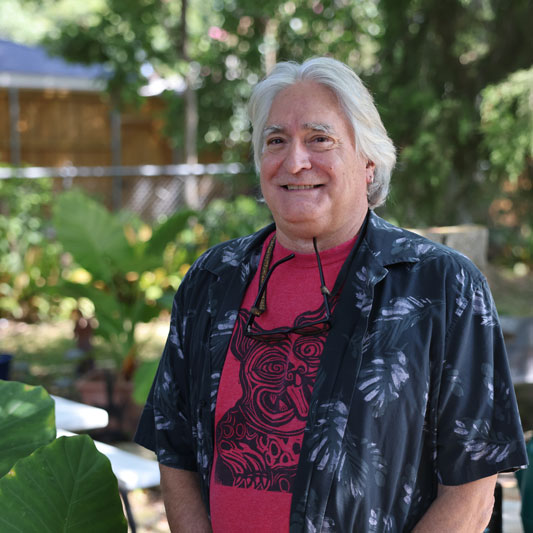
Greg
Photographer:
Marcus Miller for the American Association
for Cancer Research
Greg
Lung Cancer
In 2020, Greg went in for his annual physical expecting a routine checkup. A week earlier, he had completed a 5K race, and months before had been hiking in the Andes Mountains above 12,000 feet. He felt healthy and had never smoked.
As he was leaving the appointment, Greg casually mentioned that his breathing sounded a little unusual in the morning. His physician ordered a chest X-ray, which revealed a mass in his right lung.
After a biopsy confirmed lung cancer, Greg began treatment. His first round of chemotherapy initially worked, but the cancer returned six months later in both lungs. Surgery removed part of his lung, and additional chemotherapy treatments failed to stop the disease. A second biopsy identified a HER2 mutation, but a targeted therapy proved ineffective as well.
"There were no other options left," Greg recalls.
That's when he was referred to Dr. Reva Schneider at SCRI at Mary Crowley, Sarah Cannon Research Institute's early-phase drug development unit in Dallas, to join a clinical trial. The results came quickly.
"Within four months, my tumors had shrunk by about 80%," Greg says. "Since then, they've remained about 95% reduced."
Today, Greg continues to enjoy an active life. He swims more than a mile twice each week and still enjoys hiking, although he has learned to pace himself after treatment. Last year, he returned to his native Peru with his wife and stepdaughter to hike in the Andes Mountains and see the region's famous condors.
"I couldn't keep up the way I used to," he says. "But I'll keep going as long as I can."
For Greg, the clinical trial provided something invaluable after standard treatments had stopped working: the opportunity to keep doing the things he loves.
"The trial gave me more time and more possibilities," he says. "That's something I'll always be grateful for."
Learn more about Greg’s story in the 2026 AACR Cancer Progress Report.